 Bourd
Bourd
Tool Reviews Updated April 24, 2026

Michael Timbs Founder @ Bourd
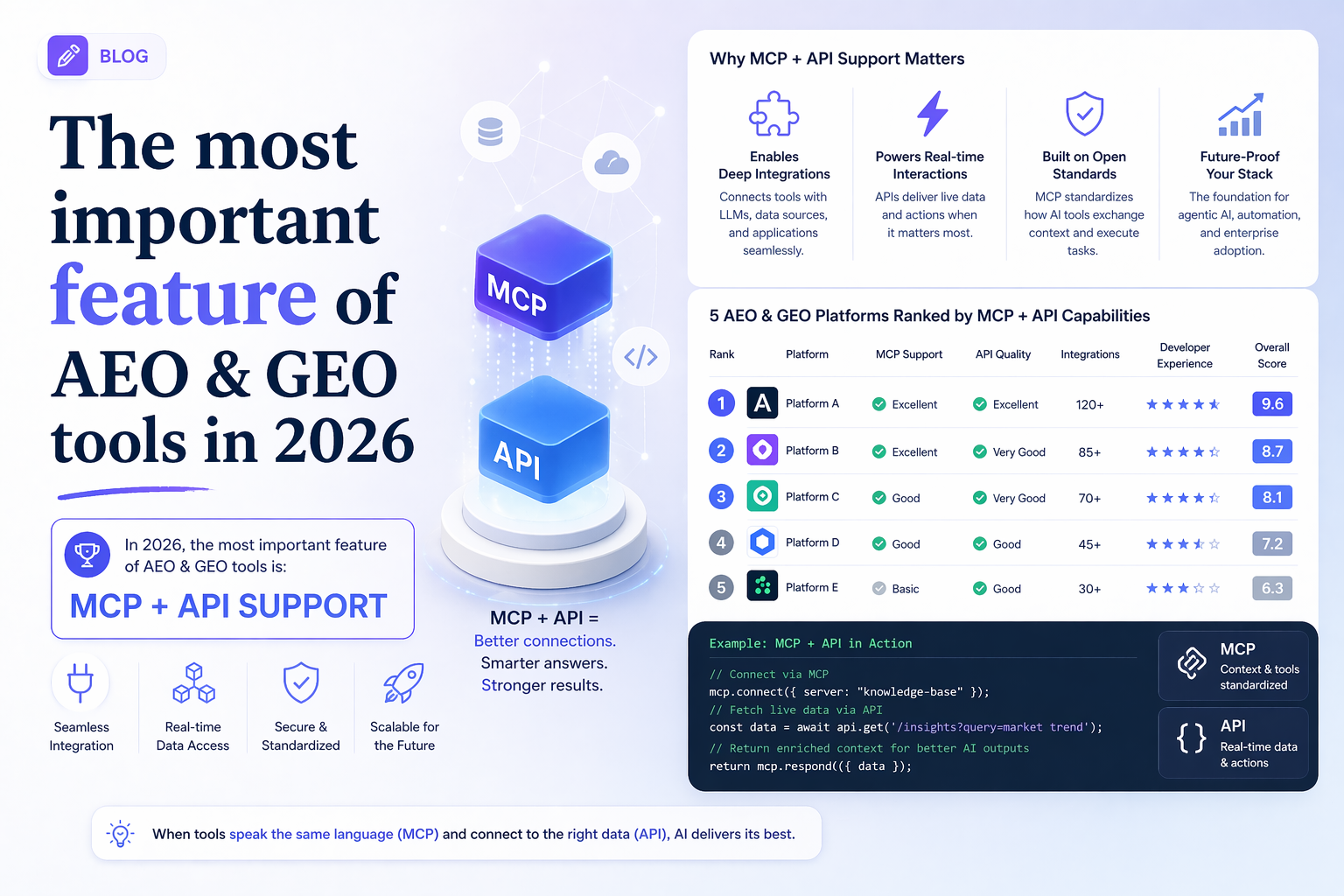
The most important feature of AEO & GEO tools in 2026
Why don't more AEO and GEO tools offer API access and MCP server support?
Why don't more AEO and GEO tools offer API access and MCP server support?
Every AEO and GEO tool on the market does roughly the same thing. Brand mention tracking. Citation analytics. Sentiment analysis. Competitive benchmarking. Multi-Provider coverage. The feature lists blur together, and the pricing clusters in the same band too.
So how do you actually pick one?
I keep coming back to the same answer: the most important feature is a full API and an MCP server, on every plan. Not gated behind enterprise pricing. Not behind a “contact us” page.
If a tool doesn’t offer that, it’s building for a world where everything happens in a dashboard. That world is over.
Most AEO tools are built around the same model: you log in, you look at charts, you read recommendations, and then you go do the work somewhere else. The tool tells you there’s a content gap around a topic your competitor is getting cited for. Great. Now someone has to write that up as a brief, check it against your brand guidelines, figure out where it fits in your editorial calendar, and get it into production. The insight was automated. Everything after it was manual.
And it gets worse for operational tasks. Want to add a new competitor to track? Log in. Want to update the prompts you’re monitoring because your product positioning shifted? Log in. Want to adjust your tracking after a rebrand? Log in, click through a bunch of forms, hope you didn’t miss anything. These are exactly the kinds of tasks that should be automatable, but without an API, they’re trapped behind a UI that requires a human in the loop for every interaction.
Some vendors have tried to close this gap by building the workflow layer themselves: content generators, editorial tools, Slack integrations, Looker connectors. On a sales demo it looks compelling. In practice, you’re now dependent on that vendor’s engineering team to build every workflow your team needs, and to build it the way your team actually works. Their content generator doesn’t know your brand voice. Their editorial workflow doesn’t match how your agency delivers to clients. Their integrations cover the tools they chose to support, not necessarily the ones you use. When the fit isn’t right, you file a feature request and wait.
What most people actually want from an AEO tool is sharp focus on the intelligence layer: track the Model Providers accurately, analyze the citations, surface the gaps and recommendations. Then make all of that accessible so their team can build on top of it.
A REST API means your existing infrastructure can pull AEO data directly. Your internal tools can surface citation gaps alongside your content calendar. Your reporting system can aggregate AEO data with every other data source you already have, formatted exactly how your stakeholders expect, without waiting for the vendor to build a connector.
An MCP server takes this further. MCP (Model Context Protocol) is how AI assistants connect to external tools and data. If your team uses Claude, ChatGPT, or any MCP-compatible agent, an MCP server means your assistant can pull live AEO data, recommendations, and competitive intelligence directly into whatever you’re working on.
Think about what that enables in practice. An agent that pulls your latest citation gaps, cross-references them against your existing content in your CMS, checks your brand guidelines, and drafts a content plan that fits your editorial calendar, all without anyone logging into the AEO tool. Or an agent that watches your competitor set and updates your prompt tracking when new players enter the space. Or one that takes your weekly AEO insights, formats them the way your agency’s clients expect, and drops them into the right folder. We catalogue real workflows others have built on Bourd MCP: share of voice digests, competitor gap scans, client-ready citation reports, and more.
Six months ago, each of those would have been a feature request to your AEO vendor. Now it’s an afternoon with a coding agent and an API key. But only if your tool gives you the access.
The puzzle: this segment is around 12 months old. None of the companies in it are burdened by legacy architecture or an old SaaS pricebook. APIs, MCPs, and integrations are becoming more important every quarter. So why are so many products ignoring them?
Otterly AI is a Gartner Cool Vendor and solid for small teams. It integrates with Semrush, which is nice if you’re in that ecosystem. But there’s no public API. Their own help center confirms it’s still on the roadmap. If you want to do anything with your data outside of their UI, you’re limited to CSV exports or a Looker Studio connector.
Goodie AI has an interesting commerce angle with GA4 attribution, but doesn’t publicly disclose pricing or API availability. In my experience, if you can’t find the API in the docs, it either doesn’t exist or it’s priced in a way that’ll surprise you.
Passionfruit does smart work connecting AI visibility to business metrics through Google Analytics. Pricing is transparent ($19–99/month), and they publish content around Shopify MCP implementations, but there’s no documented API for their core visibility data. Full breakdown: Bourd vs Passionfruit.
Profound just closed a $96M Series C at a billion-dollar valuation and calls itself the “definitive AEO leader.” The product is polished. Their Series C announcement highlights “orchestration and automation built directly into Profound.” This is a company building toward lock-in, not openness. API access is gated to Enterprise (est. $3–4k/mo). Full comparison.
Scrunch AI plans start at $250/month for brands and $500/month for agencies, and API access is gated to the Enterprise tier. MCP is listed as “coming soon.” For most teams, the cost of entry is prohibitive compared to cheaper alternatives with similar offerings. Side-by-side: Bourd vs Scrunch.
Peec AI is the one competitor that took MCP seriously. They ship a production MCP server on every plan, same as Bourd. Credit where it’s due. The API is another story: it’s gated to the Advanced tier ($495/month) and Enterprise, and Peec base plans ($95, $245, $495/month) only let you pick 3 of 7 Model Providers, with $35–$165/month add-ons for each extra. So for full programmatic access plus every Model Provider, the real entry point is closer to $500/month than the $95 sticker suggests. Side-by-side: Bourd vs Peec.
PromptWatch has a documented API, but it’s gated to the Professional plan at $249/month. The Essential plan starts at $99/month with no API access. Side-by-side: Bourd vs PromptWatch.
Rankscale AI starts at €20/month, which is the cheapest option I’ve found. For basic monitoring on a tight budget, it’s fine. They launched a REST API in early 2026, but it’s Enterprise-only at $780/month. No MCP access.
Bourd is an API-first AEO and GEO product. Every plan includes a full REST API (docs at api.geo.bourd.dev/docs) and a public MCP server (setup guide) that works with Claude, ChatGPT, and any MCP-compatible agent. No enterprise gate. No “contact us for API pricing.” API access isn’t an upsell. It’s the foundation the entire product is built on.
We don’t care if you never open our dashboard. We want to be the reliable system of record for your AI visibility data: accurate tracking across ChatGPT, Claude, Gemini, Perplexity, Grok, DeepSeek, Meta AI, and Google AI Mode, with citation analytics, content gap recommendations, and competitive intelligence. All of it accessible programmatically, designed for you to pull into whatever tools and workflows you already use.
We won’t lock in your data. We won’t force you to act on our insights inside our tools. No content workflow to adopt, no editorial calendar to learn, no reporting format you’re stuck with. You have your own infrastructure. You have your own agents. You know how your team works. Our job is to give you the core primitives (the data, the analysis, the recommendations) and get out of your way.
You shouldn’t have to wait for us to ship a feature or an integration. If you can describe what you need to a coding agent, and our API exposes the data, you should be able to build it yourself in an afternoon. That’s the bar we hold ourselves to.
We do this for one reason. Every product in this space has a fixed engineering and design budget. We want to invest 100% of ours into being the best and most economical AEO and GEO tool on the market. The things we don’t build (and don’t have to maintain) free us to do more interesting and ambitious things that actually add value.
Anyone can wrap an LLM call in a text editor and mass-produce AI-generated marketing content. That doesn’t work well. Products end up either shipping a half-baked feature so they can tick a box on their marketing page, or sinking investment into work that’s better served by a dedicated content authoring platform. Bourd is built to integrate with whatever tools you use, however you use them.
Unlimited users. Unlimited workspaces. Unlimited brands. Pricing starts at $69/month, and there’s a free tier with 1,000 credits if you want to try it.
| Bourd | Peec AI | Scrunch AI | Profound | |
|---|---|---|---|---|
| Starting price | $69/mo | $95/mo | $250/mo | $99/mo |
| API on all plans | Yes | Advanced+ ($495) | Enterprise only | Enterprise only |
| MCP server | Yes, all plans | Yes, all plans | Coming soon | No |
| Model Providers tracked | 7 (all plans) | 3 of 7 (base) | 4 of 9 (Core) | 1 (Starter) |
| Free tier / trial | 1,000 free credits | Free trial | No | No |
| Unlimited users | Yes | Yes | 5 on Core | Yes |
| Unlimited brands | Yes | Plan-dependent | 1 on Core | 1 on Starter |
Model Provider mix differs across tools. Bourd covers ChatGPT, Claude, Gemini, Perplexity, Grok, DeepSeek, and Meta AI. Peec’s seven are ChatGPT, Perplexity, Gemini, Google AI Overviews, Google AI Mode, Microsoft Copilot, and Grok.
The AEO market is going to keep consolidating. Tools that don’t offer programmatic access will either add it or lose customers to tools that do. But this isn’t really about any specific tool. It’s about a principle. Your data should be yours to use however you want. Your workflows shouldn’t be constrained by what your vendor chose to build. And in a world where agents can do real work on your behalf, the tools that make themselves programmable are the ones worth paying for.
Stop paying for data you can only access through a dashboard.
Want to try Bourd? Start free at bourd.dev. 1,000 credits, no credit card required.
Founder @ Bourd
Software engineer and data scientist. Founded my first company in 2014. Spent years alongside marketing and growth teams at startups before building Bourd. Posts here report what we see across the prompts Bourd runs on ChatGPT, Claude, Gemini, Perplexity, Grok, DeepSeek, Meta AI, and Google AI Mode.